PALM WINE
Palm wine
From Wikipedia, the free encyclopedia

Bottles and a glass of palm wine
Palm wine production by small holders and individual farmers may promote conservation as palm trees become a source of regular household income that may economically be worth more than the value of timber sold.[3]
Palm wine is known as matango, mbuh, tumbu liquor, white stuff in Cameroon; emu, nkwu, oguro in Nigeria; poyo in Sierra Leone, nsamba in the Democratic Republic of the Congo; "Manjenvo" in Cabinda Angola; nsafufuo in Ghana;[4] kallu in South India; Htan Yay (ထန်းရည်) in Myanmar; tuak in Indonesia and Malaysia; mnazi in the Mijikenda language of Kenya; bahar (Kadazan-Dusun) and goribon (Rungus) in Sabah, Borneo; vino de coyol in Central America; and tubâ in the Philippines and Mexico as well as in Borneo. In the Philippines, tubâ and "Kallu" in Tamil refers both to the freshly harvested, sweetish cloudy-white sap and the one with the red lauan-tree tan bark colorant. In Leyte, the red tubâ is aged with the tan bark for up to six months to two years, until it gets dark red and tapping its glass container gives a sound that does not suddenly stop. This type of tubâ is called bahal (for tubâ aged this way for up to six months) and bahalina (for tubâ aged thus for up to a year or more). Toddy is also consumed in Sri Lanka and Myanmar, where in Sri Lanka it is known as thal ra, kithul ra, or pol ra according to the plant used to make toddy.
Contents
Tapping


Tapping palm sap in East Timor
Palm sap begins fermenting immediately after collection, due to natural yeasts in the air (often spurred by residual yeast left in the collecting container). Within two hours, fermentation yields an aromatic wine of up to 4% alcohol content, mildly intoxicating and sweet. The wine may be allowed to ferment longer, up to a day, to yield a stronger, more sour and acidic taste, which some people prefer. Longer fermentation produces vinegar instead of stronger wine.[5]
Distilled
Palm wine may be distilled to create a stronger drink, which goes by different names depending on the region (e.g., arrack, village gin, charayam, and country whiskey). Throughout Nigeria, this is commonly called ogogoro. In some parts in Cameroon it is known as Afofo. In parts of southern Ghana distilled palm wine is called akpeteshi or burukutu. In Togo and Benin it is called sodabe, in the Philippines it is called lambanog, while in Tunisia it is called Lagmi . In parts of Kenya (coast), it is known as "chang'aa". Chang'aa can be applied to wounds to stop heavy bleeding (mechanism of action not known). In Ivory Coast, it is called "koutoukou."Consumption by region
Africa

Palm wine is collected, fermented and stored in calabashes in Bandundu Province, Democratic Republic of the Congo
In parts of southeastern Nigeria, namely Igboland, palm wine is locally referred to as “mmanya ocha” (literally, “white drink”), with “ngwo” and “nkwu” variants. It plays a very important role in traditional Igbo settings. In Urualla, for instance, and other “ideator” towns, it is the drink of choice for traditional weddings. A young man who is going for the first introduction at his in-laws’ house is required to bring palm wine with him. There are varying gallons of palm wine required, depending on the customs of the different regions in Igboland. This culture can be observed in a similar fashion in the neighbouring north-western regions of Cameroon. (North West Region).[citation needed]
There are four types of palm wine in the central and southern Democratic Republic of the Congo. From the oil palm comes ngasi, dibondo comes from the raffia palm, cocoti from the coconut palm, and mahusu from a short palm which grows in the savannah areas of western Bandundu and Kasai provinces.
India

Toddy drawer in India, 1870
In parts of India, the unfermented sap is called neera (padaneer in Tamil Nadu) and is refrigerated, stored and distributed by semi-government agencies. A little lime is added to the sap to prevent it from fermenting. Neera is said to contain many nutrients including potash[citation needed].
In India, palm wine or toddy is served as either neera or padaneer (a sweet, non-alcoholic beverage derived from fresh sap) or kallu (a sour beverage made from fermented sap, but not as strong as wine).[6] Kallu is usually drunk soon after fermentation by the end of day, as it becomes more sour and acidic day by day. The drink, like vinegar in taste, is considered to have a short shelf life.[clarification needed] However, it may be refrigerated to extend its life. Spices are added in order to brew the drink and give it its distinct taste.
In Karnataka, India, palm wine is usually available at toddy shops (known as Kallu Kadai in [Tamil], Kalitha Gadang in Tulu, Kallu Dukanam in Telugu, Kallu Angadi in Kannada or "Liquor Shop" in English). In Tamil Nadu, this beverage is currently banned, though the legality fluctuates with politics. In the absence of legal toddy, moonshine distillers of arrack often sell methanol-contaminated alcohol, which can have lethal consequences. To discourage this practice, authorities have pushed for inexpensive "Indian Made Foreign Liquor" (IMFL), much to the dismay of toddy tappers.[citation needed]

A toddy tapper belonging to Goundla caste in the state of Telangana selling toddy under the palm trees
There are two main types of kallu in states of Telangana and Andhra Pradesh, namely Thadi Kallu (from Toddy Palmyra trees) and Eetha Kallu (from silver date palms). Eetha Kallu is very sweet and less intoxicating, whereas Thati Kallu is stronger (sweet in the morning, becoming sour to bitter-sour in the evening) and is highly intoxicating. People enjoy kallu right at the trees where it is brought down. They drink out of leaves by holding them to their mouths while the Goud pours the kallu from the binki (kallu pot). There are different types of toddy (kallu) according to the season: 1. poddathadu, 2. parpudthadu, 3. pandudthadu,[citation needed].
In the Indian state of Kerala, toddy is used in leavening (as a substitute for yeast) a local form of hopper called the "Vellayappam". Toddy is mixed with rice dough and left over night to aid in fermentation and expansion of the dough causing the dough to rise overnight, making the bread soft when prepared.
In Kerala, toddy is sold under a licence issued by the excise department and it is an industry having more than 50,000 employees with a welfare board under the labour department. It is also used in the preparation of a soft variety of Sanna, which is famous in the parts of Karnataka and Goa in India.
Indonesia and Malaysia

Lithograph of a palm wine vendor and a native KNIL soldier consuming tuak (1854)

Mananguete on the way to fetch the coconut tree sap. Uses recycled plastic container to transport and store palm wine in Sibuyan Romblon, Philippines.
South America
Production of palm wine may have contributed to the endangered status of the Chilean wine palm (Jubaea chilensis).[7]Other areas
In Tuvalu, the process of making toddy can clearly be seen with tapped palm trees that line Funafuti International Airport. In Kiribati it is called Karewe and freshly tapped sap from coconut spathe is used as a refreshing drink and the fermented sap is used as an alcoholic beverage. Karewe is boiled to reduce into a thick light Brown liquid used as sweetener and spread.Consumption by animals
Some small pollinating mammals consume large amounts of fermented palm nectar as part of their diet, especially the southeast Asian pen-tailed treeshrew. The inflorescences of the bertam palm contain populations of yeast which ferment the nectar in the flowers to up to 3.8% alcohol (average: 0.6%). The treeshrews metabolize the alcohol very efficiently and do not appear to become drunk from the fermented nectar.[8]Names
There are a variety of regional names for Palm wine:| State / Territory / Region | Name used |
|---|---|
| Algeria / Tunisia | lāgmi (لاقمي in Arabic). Used for both the alcoholic and nonalcoholic form |
| Bangladesh | তাড়ি taṛi, তাড়ু taṛu, tuak[9] |
| Cambodia | Tuk tnout choo[10] |
| Cameroon | mimbo,[11] matango, mbuh, tumbu liquor, white stuff |
| People's Republic of China | 棕榈酒 (pronounced- zōng lǘ jiǔ)[12] |
| Democratic Republic of the Congo | malafu ya ngasi (Kikongo), masanga ya mbila (Lingala), vin de palme |
| Gabon | toutou |
| Gambia | singer |
| Ghana | doka, nsafufuo, palm wine, yabra, dεha (pronounced der 'ha), tér daññ |
| Guam | tuba |
| India |
|
| Indonesia | arak,[9] tuak in Indonesia. Especially in Batak region, North Sumatra, where the traditional bar serving tuak called lapo tuak. In South Sulawesi (especially in Tana Toraja) it is called ballo', and in North Sulawesi saguer. |
| Ivory Coast | koutoukou |
| Kenya | Mnazi (which means coconut palm) |
| Kiribati | Karawe |
| Libya | lāgbi [ˈlaːɡbi]. Used for both the alcoholic and nonalcoholic form. |
| Mali | bandji, sibiji, chimichama |
| Malaysia | Nira (Malay for fresh juice obtained from the blossom of the coconut, palm or sugar-palm, which can be made into sugar or the said palm wine, which is also known as Tuak[9]), toddy (English), bahar (Kadazan/Dusun), goribon (Rungus) |
| Maldives | Dhoaraa, Rukuraa, Meeraa |
| Myanmar | htan yay |
| Mexico | tuba (garnished with peanuts), originated from the Philippines |
| Namibia | omulunga, palm-wine |
| Nigeria | Palm-wine, Palmy, Ukọt nsuñ, Mmin efik, Emu, Oguro, Tombo liquor, Mmanya ngwo, Nkwu enu, Nkwu Ocha. |
| Papua New Guinea | segero, tuak |
| Philippines | tubâ, soom,[9] lambanóg (distilled tubâ), bahal (Visayan) |
| South Africa | ubusulu |
| Seychelles | kalou |
| Sierra Leone | poyo, mampama |
| Sri Lanka | Raa(Sinhala),kallu (கள்ளு), panam culloo[9] |
| Tanzania | pómbe (which means alcohol) |
| Thailand | kache, namtanmao |
| Tunisia / Algeria | Lāgmi. Used for both the alcoholic and nonalcoholic form |
| East Timor | tuaka and tua mutin, brandy is called tua sabu |
| Tuvalu | kaleve (unfermented), kao (fermented), or in English, toddy (unfermented), sour toddy (fermented) |
| Viet Nam | rượu dừa;[9] ruou dua ; coconut wine |
b Marathi.
Gallery
-
 Bowl for tuak drinking made from a gourd (late 19th century)
-
 Tapping the "arènpalm" (Arenga pinnata), one of the palms used to make palm wine, in Ambon, Moluccas (1919). The palm tree also supplies fiber to cover roofs and sugar. In the Moluccas the tree was especially appreciated because of the palm wine that can be made from the sap of the immature flower flasks. This was called toewak (Dutch), tuak or sagoweer (saguer). The fresh sap, "sugar water", was also so drunk. It is fermented to make the alcoholic beverage and can also be made into vinegar.
-
 Palm wine seller in Bali (1929)
-
 Taken in Southern Leyte, Philippines where a tuba gatherer climb the coconut tree to harvest some tuba.
-
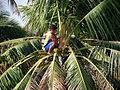 Sitting on the coconut palm while gathering tuba.
-
 Locally called "manananggot" for tuba gatherer.
-
 Gathering tuba from the coconut tree.
-
 Toddey tappers (Mergu Ravi and Burra Rajamallu) in Telangana, India.


In popular culture

Somaraju Mergu climb the toddey for palm wine(toddey water) in state of Telangana, India.
See also
- Desi daru
- Arrack, an alcoholic beverage distilled from coconut palm wine in southeast Asia.
- Palm-wine music, a West African musical genre.
- Tuak, an alcoholic beverage made of fermented rice, yeast and sugar.
- Madurai Veeran, a deity who consumes toddy.
- Sree Muthappan, another deity who consumes toddy.
- List of Indonesian beverages
- "Kithul" (Caryota urens)
References
Notes- Achebe, Chinua. Things Fall Apart. UK: William Heinemann Ltd., 1958.
Comments
Post a Comment